Monthly Archives: September 2026

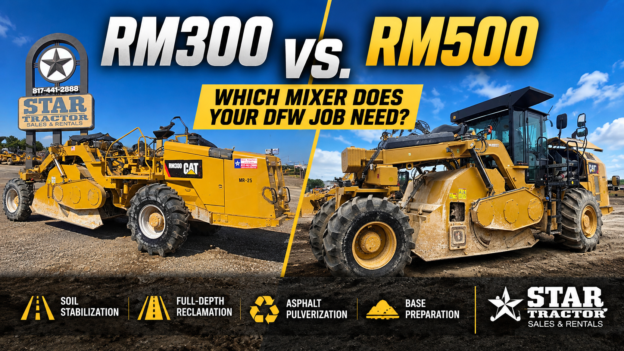
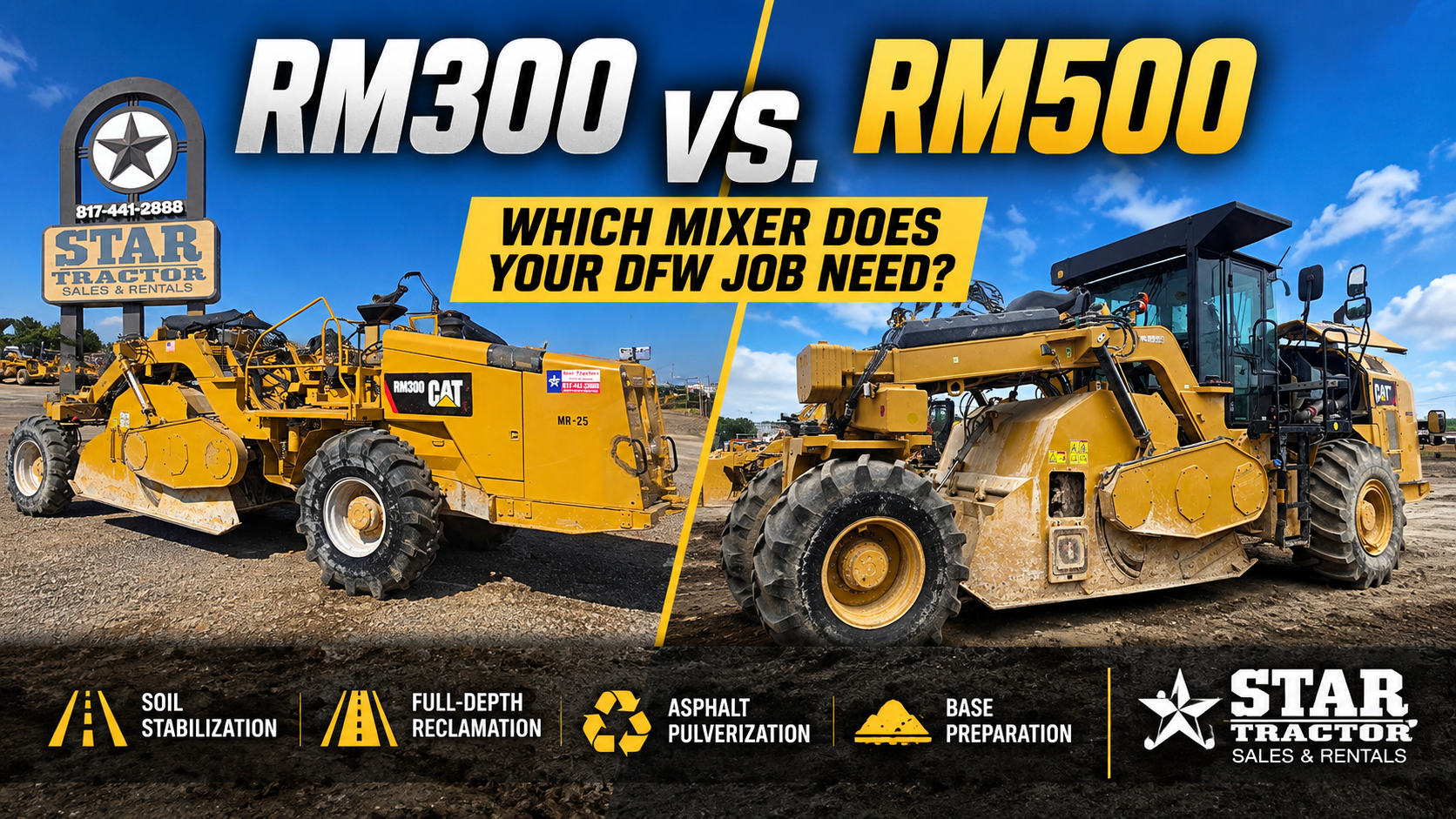
CAT RM300 vs. RM500 Rental in DFW | Which Soil Stabilizer Do You Need?

If you’re planning a soil stabilization, road reclamation, asphalt pulverization, or base preparation project in Dallas-Fort Worth, choosing the right mixer/reclaimer can have a big impact on production.

Two machines contractors may consider are the Caterpillar RM300 and Caterpillar RM500.

Both are serious machines. But bigger horsepower doesn’t automatically mean it’s the right choice for every job.

At Star Tractor Ltd. in Fort Worth, we rent heavy equipment throughout the Dallas-Fort Worth Metroplex, including CAT RM300 mixers and a CAT RM500. Here’s how I’d look at choosing between them.

What Does a CAT RM300 or RM500 Do?

These machines are commonly used for work including:

  • Soil stabilization
  • Full-depth reclamation
  • Asphalt pulverization
  • Base preparation
  • Road reconstruction
  • Site development
  • Mixing lime, cement, or other additives into existing material

For contractors, the real advantage is being able to process and improve existing material right on the jobsite.

Instead of looking only at the model number, I recommend starting with the project itself: What are you mixing? How deep are you cutting? How much material needs to be processed? And what production do you need each day?

CAT RM300: Versatility for DFW Soil Stabilization Projects

The CAT RM300 is a machine I would consider for a wide range of stabilization and reclamation applications.

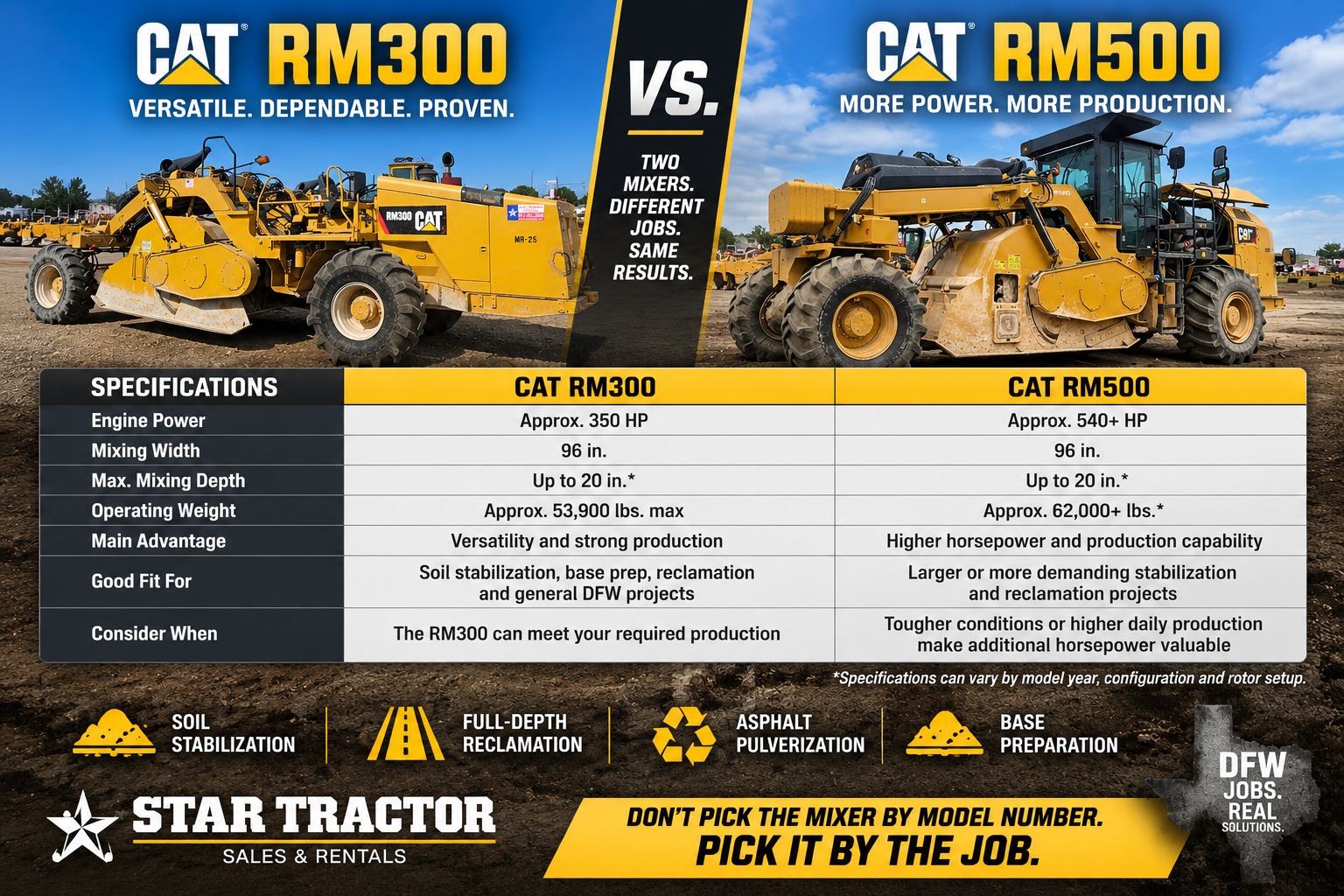
With approximately 350 gross horsepower, a 96-inch mixing width, and configurations capable of mixing to depths up to approximately 20 inches, the RM300 gives contractors plenty of capability without automatically moving into a larger machine.

That can make it a good option for projects such as commercial site development, subdivision work, road construction, parking areas, building pads and other North Texas stabilization applications.

The important thing isn’t simply whether an RM300 can do the work.

It’s whether it can achieve the production your project requires.

CAT RM500: More Horsepower When Production Matters

The CAT RM500 steps things up considerably in horsepower.

Depending on the specific model and configuration, the RM500 family offers roughly 540-plus horsepower, while maintaining approximately the same 96-inch mixing width.

That distinction is important.

Moving from an RM300 to an RM500 isn’t necessarily about making a wider pass. It’s about having more power available to process material.

On larger projects, tougher material, deeper working conditions, or jobs with aggressive production schedules, that additional horsepower can become valuable.

If your crew needs to process a significant amount of material every day, production can matter more than simply getting the lowest-cost machine onto the project.

CAT RM300 vs. RM500 Comparison

FeatureCAT RM300CAT RM500
Engine PowerApprox. 350 HPApprox. 540+ HP*
Mixing WidthApprox. 96 in.Approx. 96 in.
Maximum Mixing DepthUp to approx. 20 in.*Up to approx. 20 in.*
Main AdvantageVersatility and strong productionMore horsepower and production capability
Consider It ForGeneral stabilization and reclamationMore demanding/high-production projects

*Specifications vary by model year, machine configuration and rotor setup. Always verify the specifications of the individual rental machine for your application.

Which Mixer Should You Rent?

I wouldn’t make that decision based on horsepower alone.

Before choosing an RM300 rental or RM500 rental in DFW, I’d look at five things:

  1. Material — What type of soil, base or pavement are you processing?
  2. Depth — How deep does the project require you to work?
  3. Total quantity — How much material needs to be processed?
  4. Daily production — How much work needs to get done per shift?
  5. Schedule — How much pressure is there to keep the project moving?

If the RM300 comfortably meets those requirements, stepping up to an RM500 may not be necessary.

But if you’re dealing with tougher conditions or need higher production, that’s where the additional horsepower of the RM500 deserves consideration.

Why Rent a Soil Stabilizer Instead of Buying One?

Mixers and reclaimers are specialized pieces of equipment.

Some contractors may keep them working constantly. Others need one for a particular phase of a project and then may not need another for months.

That’s one reason renting a soil stabilizer in DFW can make sense.

You can bring the machine onto the job when you need it without tying up capital in specialized equipment that could sit between projects.

Rental can also make sense when you unexpectedly pick up another stabilization project, need additional production alongside equipment you already own, or need to replace a machine that’s temporarily down.

CAT RM300 and RM500 Rentals in Dallas-Fort Worth

Star Tractor is a family-owned heavy-equipment company located on Equipment Row in Fort Worth, Texas. We’ve been in business since 2002 and maintain a fleet of more than 100 machines.

We rent heavy equipment throughout the Dallas-Fort Worth Metroplex and sell equipment nationwide and worldwide.

Our rental machines go through a thorough inspection after every rental. If something needs attention, we want to address it before that machine goes back to another contractor.

For contractors looking for a CAT RM300 rental in Dallas, Fort Worth, or the surrounding DFW area, we have multiple RM300 mixers in the rental fleet. We’ve also added a CAT RM500 for contractors who need another option for larger or more demanding applications.

Need an RM300 or RM500 for a DFW Project?

Don’t pick the mixer by model number. Pick it by the job.

Tell me what you’re mixing, your required depth, the size of the project and the production you’re trying to achieve. We can talk through whether an RM300 or RM500 makes more sense.

If you have an upcoming soil stabilization, full-depth reclamation, asphalt pulverization or road construction project anywhere in the Dallas-Fort Worth Metroplex, give me a call.

Kevin Cook

Star Tractor Ltd.
817-733-3799
Caterpillar 320 Excavator vs. Deere 670GP Motor Grader: Which Machine Does Your DFW Project Need?

A Caterpillar 320 excavator and a Deere 670GP motor grader can both play important roles on a construction site, but they handle very different parts of the job.

The Cat 320 performs the digging and material-handling work. The Deere 670GP shapes the surface and brings the project closer to the required grade. Depending on the work, a contractor may need one machine—or both.

Here is a practical look at where each machine fits and what DFW contractors should consider before renting or buying equipment.

What Is a Caterpillar 320 Excavator Used For?

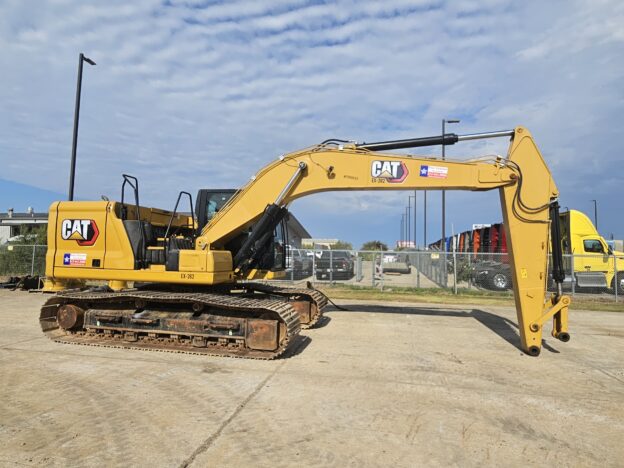
The Caterpillar 320 is a crawler excavator commonly used for excavation, utility work, site development and material handling. Its tracks allow it to work on rough or uneven ground while the boom, stick and bucket handle digging and loading operations.

Common Cat 320 applications include:

  • Digging foundations and building pads
  • Cutting trenches for water, sewer and utility lines
  • Loading dirt or demolition material into trucks
  • Removing unsuitable material
  • Excavating drainage structures and retention areas
  • Clearing and preparing construction sites
  • General earthmoving and demolition work

For contractors who need to dig below grade, move material from a fixed position or load trucks, an excavator is usually the right starting point.

What Is a Deere 670GP Motor Grader Used For?

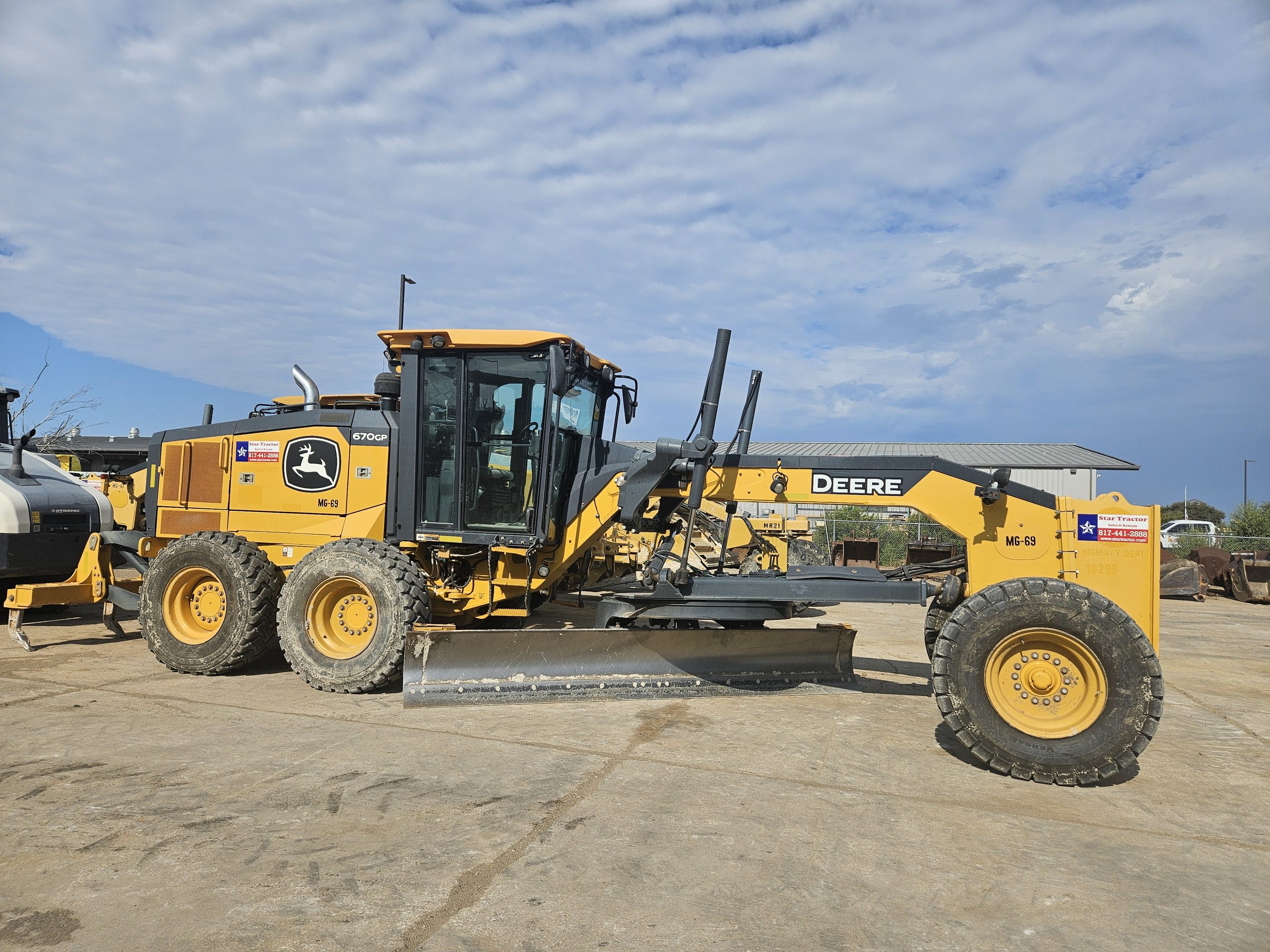
The Deere 670GP motor grader is built for shaping, spreading and finishing material. It can establish slopes, crown roads and produce a smoother, more accurate surface after the heavier excavation work has been completed.

Common Deere 670GP applications include:

  • Building and maintaining roads
  • Finish-grading commercial and industrial sites
  • Shaping building pads
  • Maintaining jobsite and haul roads
  • Spreading and leveling base material
  • Cutting drainage slopes and ditches
  • Preparing surfaces for paving or concrete

The “GP” designation identifies Deere’s Grade Pro configuration. Actual installed grade-control equipment can vary by machine, so contractors should always confirm the specific configuration before renting or purchasing.

The Main Difference Between an Excavator and a Motor Grader

The simplest way to separate these machines is to look at the work they perform.

The Caterpillar 320 excavator digs, removes and loads material. The Deere 670GP motor grader shapes, spreads and finishes it.

An excavator can cut a trench or remove unwanted soil, but it is not designed to produce the same broad, controlled finish as a motor grader. A grader can move and shape loose material across a surface, but it is not intended to perform deep excavation or efficiently load trucks.

Choosing the wrong machine can reduce production, increase operating time and make it harder to achieve the required result.

When a Project May Need Both Machines

Many earthmoving and site-development projects require an excavator and a motor grader at different stages.

For example, the Cat 320 may first be used to:

  • Excavate utilities
  • Remove unsuitable soil
  • Dig drainage areas
  • Load excess material into articulated trucks

The Deere 670GP can then be used to:

  • Spread replacement material
  • Shape the subgrade
  • Build slopes and drainage
  • Maintain access roads
  • Prepare the surface for the next construction phase

This combination can be useful on roadwork, commercial site development, utility projects, subdivisions and large building-pad jobs throughout the Dallas-Fort Worth area.

Questions to Ask Before Choosing a Machine

Before deciding what equipment belongs on the job, consider these questions:

Does the work require digging below grade?

If the project involves trenches, foundations, drainage structures or removing deep material, the Cat 320 will likely be the better choice.

Does the surface need to be shaped or finished?

If the goal is to establish elevation, create a road crown, shape a pad or prepare a smooth surface, the Deere 670GP is likely the more appropriate machine.

Will material need to be loaded into trucks?

An excavator is built to dig and load material. If dirt must be removed from the site, consider the entire production setup—including the excavator, trucks and disposal location.

What type of material is on the job?

Soil conditions affect machine selection and production. Wet ground, rock, compacted material and loose fill can each require a different approach.

How much work must be completed?

A machine should fit the size, schedule and production requirements of the project. The right equipment is not simply the largest available machine—it is the machine that can perform the work efficiently.

Do you need the machine temporarily?

If the equipment is needed for one project, a specific phase or a temporary increase in workload, renting may make more sense than purchasing.

Renting Heavy Equipment in DFW

Renting gives contractors the flexibility to add equipment when workloads increase, replace a machine that is down or handle a job that requires equipment they do not regularly own.

It may be a practical option when:

  • A new project creates a temporary equipment need
  • A contractor wants to avoid tying up capital
  • A particular machine is only needed for one phase
  • An existing machine is being repaired
  • The schedule requires additional production

Rental availability can change as machines leave for jobs and return to the yard, so it is worth checking early when a project is being scheduled.

Star Tractor rents heavy equipment throughout the Dallas-Fort Worth Metroplex. Every rental machine receives a thorough inspection after every rental—no shortcuts.

Buying Equipment for Longer-Term Needs

If a contractor expects to use a machine regularly and has enough work to keep it productive, purchasing may be the better long-term decision.

Buyers should evaluate:

  • Machine hours
  • Maintenance history
  • Overall condition
  • Undercarriage or tire condition
  • Attachments and configuration
  • Technology installed on the machine
  • Transportation requirements
  • Expected utilization

Star Tractor sells heavy equipment nationwide and worldwide. Specific hours, attachments, condition and pricing should always be confirmed for the individual machine being considered.

Which Machine Is Right for Your Project?

Choose the Caterpillar 320 when the job primarily requires digging, trenching, loading or material removal.

Choose the Deere 670GP when the work primarily involves shaping roads, building pads, spreading material or finish grading.

If the project includes major excavation followed by surface preparation, the best answer may be both.

The right decision depends on what material must be moved, how accurately the site must be graded, how long the equipment is needed and what other machines are already working on the project.

Need help matching equipment to your next DFW project?

Call me at 817-733-3799.

Kevin Cook
Star Tractor Ltd.

Rent Caterpillar Mixers

Ultimate Caterpillar RM300 Rental in DFW for Soil Stabilizers

Rental options in North Texas

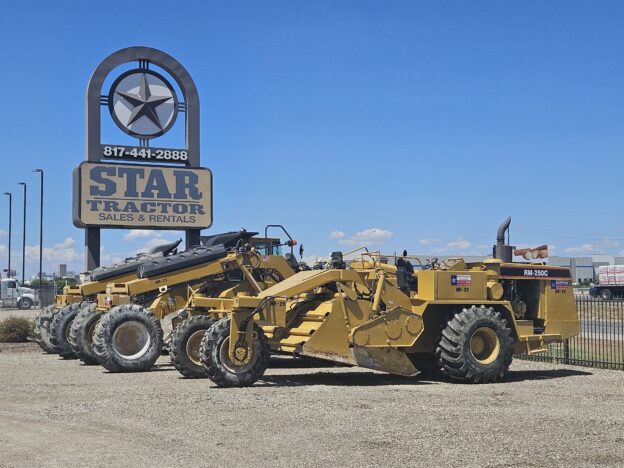
Additionally, for soil stabilization, road reclamation, or site-development projects in North Texas, Star Tractor offers Caterpillar RM300 mixers for rent.

They are available for rent across the Dallas–Fort Worth Metroplex.

Additionally, the caterpillar rm300 mixers are a specialized tool that not every contractor needs in the fleet year-round.

However, when stabilization or reclamation work is needed, access to the right equipment can boost production.

That’s where renting an RM300 can make sense.

What Is a Caterpillar RM300 Used For?

The Caterpillar RM300 is a soil stabilizer/reclaimer designed to process and mix material in place.

Depending on the project and specifications, contractors may use this type of machine for:

  • Soil stabilization
  • Full-depth reclamation
  • Road rehabilitation
  • Subgrade improvement
  • Base preparation
  • Site-development work
  • Mixing existing material with lime, cement, or other stabilizing agents

For highway, road, civil, utility, commercial development, and large site-work contractors, processing existing material in place can be important.

Additionally, it helps keep a project moving efficiently.

Caterpillar RM300 for Soil Stabilization

North Texas contractors know that soil conditions can create challenges long before the finished road, building pad, parking lot, or development begins taking shape.

When project specifications call for soil stabilization, a reclaimer/mixer can be used to thoroughly mix the existing material with the specified stabilizing agent.

The RM300 is built specifically for this type of demanding work.

Rather than looking at the machine as simply another piece of heavy equipment, contractors should think about what it can do for the overall operation: process material and keep stabilization work moving so the crews behind it can continue making progress.

Using an RM300 for Road Reclamation

Additionally, road rehabilitation is another application where machines like the Caterpillar RM300 come into play.

Full-depth reclamation can allow existing roadway material to become part of the reconstructed base rather than treating everything as material that must automatically be removed and replaced.

The exact process depends on the engineering specifications and project requirements, but the ability to reclaim and process existing material in place can provide contractors with another option when tackling roadway rehabilitation projects.

That makes RM300s especially relevant for contractors involved in road, highway, municipal, civil, and infrastructure construction throughout DFW and North Texas.

Why Rent a Caterpillar RM300?

A soil stabilizer/reclaimer is a specialized piece of equipment.

If stabilization isn’t part of your everyday workload, purchasing a machine may not make sense for every operation.

Renting gives contractors another option.

You may need an RM300 because you:

  • Won a project requiring stabilization or reclamation
  • Need additional production on an existing job
  • Have multiple projects running simultaneously
  • Need another machine temporarily
  • Don’t want to own a specialized machine that may sit between projects

The important thing is having access to the equipment when the work is ready.

Caterpillar RM300 Rentals in Dallas-Fort Worth

Star Tractor rents heavy equipment throughout the Dallas-Fort Worth Metroplex.

Additionally, we have caterpillar rm300 mixers available for rent.

We’re located in Fort Worth, Texas, right on Equipment Row, and we’ve been in the heavy-equipment business since 2002.

One thing I think is especially important when you’re renting a machine is knowing how that equipment has been treated between jobs.

At Star Tractor, every rental machine is thoroughly inspected after every rental.

Whether a machine was gone for a short rental or spent an extended period on a project, it goes through our inspection process when it comes back. When something needs to be repaired, we address it properly.

No shortcuts.

Our goal is straightforward: provide contractors with dependable late-model equipment and responsive service so they can concentrate on getting their work done.

Planning a DFW Stabilization Project?

Don’t wait until your crew is ready to start mixing material before figuring out where you’re going to get the machine.

If you’re bidding or planning a project involving soil stabilization, road reclamation, base work, or site development in the Dallas-Fort Worth area, it’s worth checking RM300 rental availability ahead of time.

If your project is already underway, you may need another mixer to increase production.

Additionally, call me and let’s see what we can do.

Need an RM300? Call Me.

We currently have Caterpillar RM300 mixers available for rent in the DFW Metroplex.

If you need specifications, rental information, or want to discuss whether we have an RM300 that fits your upcoming project, give me a call.

Call me at 817-733-3799.

Kevin Cook
Star Tractor Ltd.
Fort Worth, Texas